A process intelligence platform helps enterprise teams see how work actually moves through the organization, where it breaks, and which improvements deserve attention first.
That sounds simple. In practice, most transformation teams are working from partial evidence. System logs show what happened inside structured applications. Workshops capture what a few people remember. Surveys reveal sentiment, but not always the process detail behind it. Automation teams can see promising tasks, but not always the cross-functional context that makes those tasks matter.
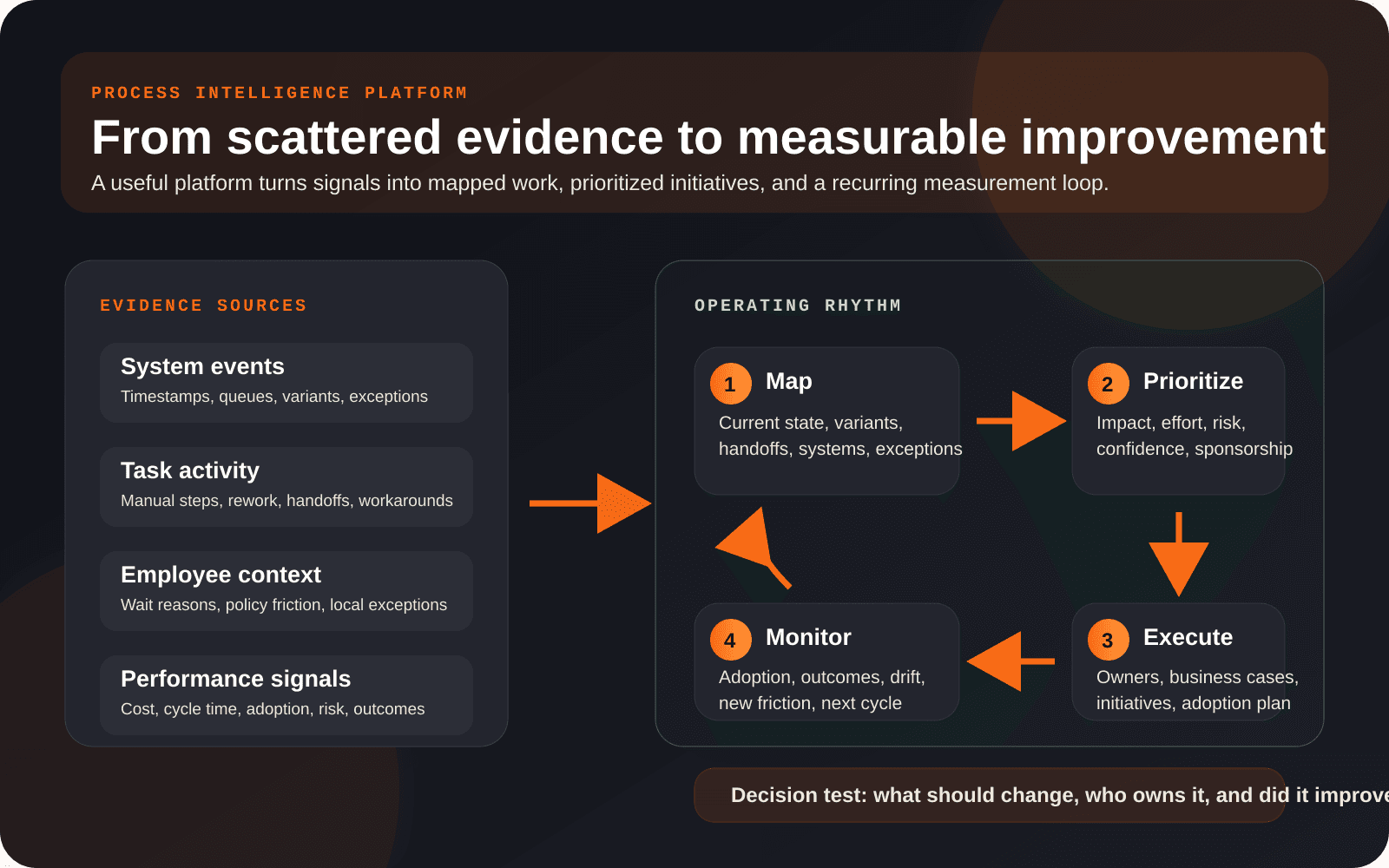
Process intelligence is the attempt to turn those fragments into a living operating view. The strongest platforms do more than document a process once. They help leaders map the current state, identify variation, quantify opportunities, prioritize initiatives, and monitor whether change is actually working.
For large enterprises, that last step is the difference between diagnosis and delivery.
What Is a Process Intelligence Platform?
A process intelligence platform is software that helps organizations mine, map, analyze, design, monitor, and improve business processes across teams and systems.
Gartner describes process intelligence platforms as tools that combine development and runtime capabilities to mine, analyze, model, design, and monitor processes. That definition matters because the category is broader than classic process mining. A process intelligence platform reconstructs what happened in a system and helps leaders understand what is happening, why it is happening, and what to do next.
In practical terms, a process intelligence platform usually helps teams answer questions like:
- Where does this process slow down?
- Which variants are normal and which create avoidable cost or risk?
- Which handoffs create rework?
- Which tasks are strong candidates for automation?
- Which improvement opportunities are worth funding first?
- Are implemented changes being adopted by teams?
- Did the initiative create measurable business impact?
The output is a map and a better decision system for transformation work.
A useful definition: a process intelligence platform turns process and work signals into a continuous view of how the business runs, where improvement opportunities exist, and how those opportunities should be prioritized and executed.
Why Process Intelligence Is Moving Beyond Process Mining
Process mining gave enterprises a powerful way to reconstruct process flows from system event logs. It can show how a purchase order, claim, invoice, support ticket, or customer request moved through a system. It can reveal variants, loops, delays, and conformance issues that would be hard to spot manually.
But event logs are only one version of operational reality.
Many of the most important process problems live between systems or outside them entirely: informal approvals, spreadsheet workarounds, local exceptions, repeated clarification messages, manual checks, and policy interpretations that never appear cleanly in an ERP or CRM. System data can show that a case was delayed. It may not show that a team was waiting on a regional policy owner, using a workaround because the official workflow was too rigid, or duplicating work because another function did not trust the data.
That is why the market has been expanding from process mining toward process intelligence. The shift is from retrospective analysis toward continuous understanding and action.
A more complete process intelligence platform brings together:
- Process mining from system event logs
- Task-level insight from user or workflow activity
- Process documentation and modeling
- Performance monitoring and alerting
- Opportunity scoring and decision support
- Employee and stakeholder context
- Initiative tracking after improvement work begins
This broader view is especially important as enterprises push more AI into operations. AI systems need trusted context. If the model only sees the official process, it may automate the wrong step. If leaders only see aggregate dashboards, they may miss the local behavior that explains why a process keeps drifting. Process intelligence should create the operating context that people and AI both need to make better decisions.
Process Intelligence vs. Process Mining, Task Mining, and Process Discovery
The terms in this market overlap, but they are not interchangeable.
Process Mining
- What it does: Reconstructs process flows from event logs in enterprise systems.
- Where it is strongest: Finding variants, delays, loops, and conformance issues inside structured workflows.
- Common limitation: Misses work that happens outside the tracked systems.
Task Mining
- What it does: Captures user-level tasks across desktops or applications.
- Where it is strongest: Finding repetitive manual work and automation candidates.
- Common limitation: Can be narrow if it only observes selected users or tools.
Process Discovery
- What it does: Maps how a process works today using data, interviews, workshops, observation, or AI-led discovery.
- Where it is strongest: Building a current-state understanding before transformation.
- Common limitation: Can become a one-time diagnostic if not connected to execution.
Process Intelligence Platform
- What it does: Combines process data, work signals, analytics, monitoring, prioritization, and improvement workflows.
- Where it is strongest: Turning process visibility into ongoing transformation decisions.
- Common limitation: Weak platforms stop at dashboards instead of driving action.
A simple way to think about it: process mining and task mining are inputs. Process discovery is a method for understanding the current state. Process intelligence is the operating layer that turns that understanding into continuous improvement.
What a Process Intelligence Platform Should Do
The exact feature set varies by vendor, but enterprise teams should expect a process intelligence platform to do six jobs well.
1. Connect Data From Systems, Workflows, and People
A platform should ingest process signals from the systems where work happens: ERP, CRM, workflow tools, service platforms, project systems, and other operational applications.
But data coverage should not stop at systems. The platform also needs a way to understand the human layer: why work is routed a certain way, why teams use exceptions, where employees see friction, and which changes would actually be adopted. Without that context, leaders can identify symptoms but still misunderstand root causes.
2. Map the Real Current State
Process intelligence should show the real flow of work, not the idealized process in a slide deck.
That means surfacing the main path, common variants, rework loops, handoffs, delays, and undocumented steps. For transformation leaders, the current-state map is useful only if it is trusted by the people who live the process every day.
3. Find Bottlenecks, Variants, Rework, and Compliance Gaps
Once the current state is visible, the platform should highlight what deserves attention. Common findings include:
- Steps with long wait times
- Handoffs that create repeated clarification
- Variants that increase cost or risk
- Rework caused by incomplete inputs
- Compliance gaps or skipped controls
- Manual tasks with automation potential
- Teams or regions with unusually high process friction
The goal is not to produce a long list of defects. The goal is to separate noise from material improvement opportunities.
4. Prioritize Opportunities by Impact, Effort, and ROI
A common failure mode in transformation is treating every insight as equally important. Teams collect findings, create a backlog, and then struggle to decide what to fund.
A process intelligence platform should help rank opportunities by business impact, implementation effort, risk, and expected return. This is where process visibility becomes executive decision support. The best opportunities are not always the most obvious bottlenecks. They are the improvements with enough evidence, urgency, feasibility, and sponsorship to move.
5. Turn Insights Into Initiatives
Dashboards do not transform a business by themselves. Once a team identifies an opportunity, the work shifts to ownership, business case creation, implementation planning, stakeholder alignment, and adoption.
A strong platform should make that handoff easier. It should help teams move from "we found a problem" to "this is the initiative, this is the owner, this is the expected value, this is the plan, and this is how we will know it worked."
6. Monitor Adoption and Improvement After Launch
Processes change after the first intervention. Teams adapt, exceptions return, new constraints appear, and adoption varies by function or region.
Process intelligence should therefore be continuous. Leaders need to know whether the target process is being followed, whether employees are adopting the change, whether the expected savings are materializing, and whether new friction has appeared.
Common Process Intelligence Use Cases
Process intelligence is useful anywhere leaders need to understand, improve, or monitor complex work. The strongest use cases tend to sit at the intersection of operational complexity and executive urgency.
Operational Excellence and Continuous Improvement
Operational excellence teams use process intelligence to find inefficiencies, prioritize improvements, and monitor whether changes improve cycle time, cost, quality, or customer experience.
Transformation Office Prioritization
Transformation offices need a reliable way to decide which initiatives matter most. Process intelligence can help compare opportunities across functions, estimate value, and build a more evidence-backed roadmap.
Shared Services and Back-Office Improvement
Finance, HR, procurement, customer operations, and other shared services teams often run high-volume processes with many exceptions. Process intelligence can reveal where requests stall, which teams create rework, and which process variants should be standardized.
Automation Pipeline Discovery
Automation teams can use process intelligence to find repetitive, rules-based work. The important caveat: automation should follow understanding. If a broken process is automated too early, the enterprise may simply scale the wrong behavior.
Enterprise AI Readiness
Enterprise AI depends on operational context. Before leaders delegate work to AI agents or redesign workflows around AI, they need to know how work flows today, where human judgment matters, and which process rules should be preserved or changed.
Compliance and Control Monitoring
In regulated environments, process intelligence can help monitor whether controls are being followed, where exceptions are increasing, and which process variants create risk.
Post-Change Adoption
After a transformation initiative launches, leaders need to know whether teams are adopting the new process. Continuous feedback and monitoring can identify where a change is working, where it is being bypassed, and where additional support is needed.
How to Evaluate Process Intelligence Software
The right process intelligence software depends on your operating model, data environment, and transformation goals. Use these criteria to compare platforms.
Data Coverage
Look for connections to core systems, workflow tools, process documentation, and employee feedback. Narrow data coverage creates narrow conclusions.
Human Context
Look for the ability to capture why process variation happens and what employees experience. Root causes often live outside event logs.
Prioritization
Look for impact, effort, ROI, risk, and feasibility scoring. Leaders need to decide what to fund first.
Execution Support
Look for initiative owners, business cases, implementation plans, and progress tracking. Insight has value only when it turns into action.
Governance
Look for role-based access, privacy controls, anonymization, and enterprise security. Process intelligence often touches sensitive operational and employee data.
Scalability
Look for support for multiple functions, countries, processes, and employee populations. Enterprise transformation rarely happens in one team.
Speed to Insight
Look for time to first useful findings, before the full implementation is complete. Transformation teams need momentum quickly.
Monitoring
Look for ongoing pulse checks, process tracking, and post-change feedback. Improvement needs to be sustained, not announced once.
The most important question is not "Which platform has the most dashboards?" It is "Which platform will help our organization make better transformation decisions and follow through?"
Where Horizon Fits in the Process Intelligence Category
Horizon is an AI-powered continuous discovery platform. Its role in process intelligence is the people-led layer: understanding how work happens through employee conversations, surfacing evidence-backed opportunities, and helping teams move those opportunities into execution.
That matters because many process issues are not visible from system data alone. Employees know where handoffs fail, where policies create workarounds, where tools do not match the real workflow, and which improvements would save time without creating new risk.
Horizon supports that loop through:
- Discovery Cycles, which run AI-led conversations with employees at scale
- Insights Dashboard, which turns discovery into structured, evidence-backed findings
- Initiatives Dashboard, which helps teams turn opportunities into business cases and implementation plans
- Process Library, which creates living process documentation from employee input
- Pulse and follow-up loops that help teams keep discovery current after the first diagnostic pass
For enterprises already using system-led process mining, Horizon can add the human and execution context that makes the findings more actionable. For teams earlier in their process intelligence journey, Horizon can provide a faster way to build a trusted view of work across functions before committing to a transformation roadmap.
The category lesson is clear: process intelligence should give teams enough understanding to improve the process, rather than visibility alone.
FAQ
What is the difference between process intelligence and process mining?
Process mining analyzes event logs from enterprise systems to reconstruct process flows and identify variants, bottlenecks, or conformance issues. Process intelligence is broader. It can include process mining, task mining, process discovery, monitoring, prioritization, and execution support so teams can move from visibility to improvement.
Is process intelligence only for automation?
No. Automation is one common use case, but process intelligence also supports operational excellence, transformation planning, shared services improvement, compliance monitoring, enterprise AI readiness, and post-change adoption. The goal is to improve work, including the parts that should be automated and the parts that need better design, ownership, or adoption.
What data does a process intelligence platform use?
A process intelligence platform may use event logs, workflow data, task activity, process documentation, performance metrics, employee feedback, interviews, and follow-up signals. The best data mix depends on the process and the decision the team needs to make.
How is process intelligence related to enterprise AI?
Enterprise AI needs accurate operating context. Process intelligence helps leaders understand how work flows today, where AI could help, which rules and controls matter, and where human judgment still needs to stay in the loop.
See How Horizon Adds the People Layer to Process Intelligence
If your transformation team needs a clearer view of how work actually happens, Horizon can help you move from assumptions to evidence. It talks to employees at scale, maps recurring process friction, prioritizes the highest-impact opportunities, and helps teams turn insights into initiatives.