An AI maturity model helps an enterprise understand how ready it is to create, govern, scale, and measure AI. The useful version is not a generic score. It shows where AI is still a set of isolated experiments, where repeatable capabilities already exist, and which gaps must be fixed before the organization can rely on AI in everyday operations.
For transformation and operations leaders, the model should answer four questions:
- Where are we today?
- Which capabilities are holding us back?
- What level of maturity do we actually need for each part of the business?
- What should we fund, fix, or stop next?
That last question matters most. An AI maturity assessment only creates value when it turns into a prioritized roadmap grounded in real work: how employees actually complete tasks, where processes break down, which use cases are worth scaling, and how teams will follow through after the assessment.
What is an AI maturity model?
An AI maturity model is a structured framework for assessing an organization's ability to use artificial intelligence in a reliable, governed, and value-producing way. It usually combines two views:
- Maturity stages that describe how advanced the organization is, from ad hoc experimentation to enterprise-wide optimization.
- Capability dimensions that show what must mature, such as strategy, data, technology, governance, skills, workflow design, and value measurement.
The stage tells leaders the overall pattern. The dimensions show where the bottlenecks are.
For example, a company may have strong executive ambition and several promising pilots, but weak data access, unclear ownership, and no adoption plan. Calling that company "Stage 3" or "Stage 4" hides the real issue. AI maturity is uneven by design, and the roadmap should focus on the dimensions that block safe scale.
It is also a mistake to target the highest level everywhere. Some functions need advanced AI operations because they run high-volume, high-value workflows. Others may only need governed pilots, better data readiness, or a clear use-case intake process. The goal is not symbolic maturity scoring. The goal is the right level of maturity for the business outcome.
The five stages of AI maturity
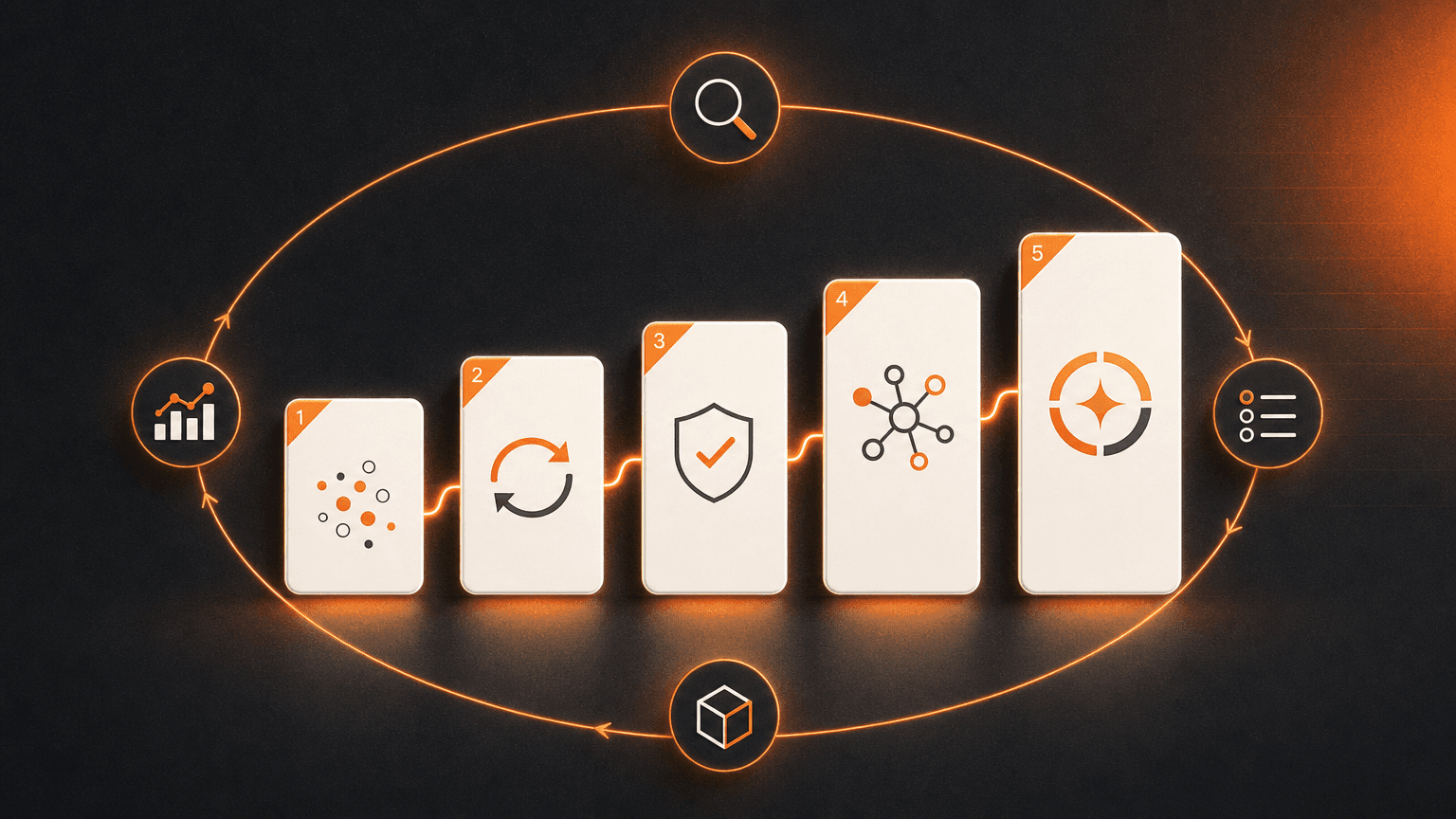
Most enterprise AI maturity models move through a similar arc: experimentation, repeatability, governance, scale, and continuous optimization. The names vary, but the operating pattern is consistent.
| Stage | What it looks like | Leadership question | Next move |
|---|---|---|---|
| 1. Experimental | AI activity depends on individual teams or enthusiastic employees. Pilots are informal, tool-led, and hard to compare. | Which experiments are safe, useful, and connected to business priorities? | Set basic guardrails, create a use-case intake process, and identify the first business-owned pilots. |
| 2. Repeatable | Teams can repeat a few patterns. There is an executive sponsor, early standards, and some shared learning, but adoption is still uneven. | Which pilots deserve investment, and what capabilities must be standardized? | Prioritize use cases, define data and security requirements, and create lightweight delivery standards. |
| 3. Governed | AI initiatives have formal ownership, reusable architecture, risk controls, KPI expectations, and clearer links to business processes. | Are we scaling the right use cases in the right way? | Build the operating model, redesign workflows around AI, and measure value beyond pilot completion. |
| 4. Scaled | AI is embedded across multiple functions. Teams manage a portfolio, track adoption, coordinate governance, and improve processes after launch. | Which AI-enabled workflows are changing cost, speed, quality, risk, or customer experience? | Strengthen cross-functional ownership, fund the highest-value roadmap, and create a recurring value cadence. |
| 5. Adaptive | AI becomes part of the operating rhythm. The organization continuously discovers opportunities, improves workflows, and uses governed automation or agents where appropriate. | How do we keep improving safely as AI capabilities and business needs change? | Add continuous monitoring, feedback loops, and controls for higher-autonomy AI. |
This five-stage model is intentionally practical. It gives leaders a shared language without pretending that every department will progress at the same speed.
A company may be scaled in customer support, governed in finance, and still experimental in HR. That is normal. What matters is whether leaders can see the gaps clearly enough to act.
The seven capability dimensions to score
A strong AI maturity assessment scores dimensions separately. Averaging everything into one number can hide the specific constraint that prevents scale.
| Dimension | What to test | Weak signal | Mature signal |
|---|---|---|---|
| 1. Strategy and business outcomes | Whether AI work is tied to clear business priorities and executive decisions. | Teams chase tools or generic productivity ideas. | AI priorities are connected to measurable outcomes, strategic boundaries, and a living enterprise AI strategy. |
| 2. Data and technology foundation | Whether data, architecture, integrations, security, and deployment patterns can support repeatable AI use cases. | Every pilot needs a custom setup and manual data work. | Teams reuse approved architecture, data access patterns, model evaluation methods, and deployment standards. |
| 3. Governance, risk, and trust | Whether AI is designed, reviewed, monitored, and improved with clear controls. | Governance appears after a pilot is built, or risk ownership is unclear. | Governance is part of the delivery lifecycle, aligned with frameworks such as the NIST AI Risk Management Framework, and matched to the risk level of each use case. |
| 4. Process visibility and workflow redesign | Whether the organization understands how work actually happens before inserting AI. | Use cases are chosen from assumptions, executive anecdotes, or system logs alone. | Teams use a process intelligence platform, employee input, and workflow evidence to redesign work before scaling AI. |
| 5. People, adoption, and skills | Whether employees know when, why, and how to use AI in their work. | Training is optional, adoption is measured by license usage, and frontline concerns arrive late. | Adoption plans include role-based enablement, visible feedback loops, and employee feedback at scale. |
| 6. Use-case portfolio and prioritization | Whether leaders can compare AI opportunities by value, readiness, effort, risk, and adoption complexity. | The loudest stakeholder wins, or every team keeps its own AI backlog. | Use cases are scored through an AI use case prioritization framework and reviewed as a portfolio. |
| 7. Operating model and follow-through | Whether ownership, funding, governance, implementation, and measurement continue after the assessment. | The roadmap is a slide deck with no owners or cadence. | An AI operating model defines decision rights, delivery rhythm, value tracking, and improvement loops. |
The dimensions also make the maturity conversation more honest. A team with strong models but weak adoption is not mature. A team with strict governance but no business prioritization is not mature either. Enterprise AI maturity requires the whole system to work together.
How to run an AI maturity assessment
Use the assessment to make decisions, not to create a static benchmark. A practical assessment has five steps.
1. Choose the scope and decision
Start by defining what the assessment should inform. Are you assessing the whole enterprise, one region, one function, or one transformation program?
Then define the decision it should support. Examples:
- Which AI use cases should receive funding next quarter?
- Which capabilities must be fixed before scaling copilots or agents?
- Which functions are ready for workflow redesign?
- Where do governance, data, or adoption gaps create unacceptable risk?
A broad maturity score is less useful than a scoped assessment tied to a real planning decision.
2. Gather evidence from the work itself
Do not rely only on executive workshops or survey responses. They are useful, but they often miss the friction that shapes AI adoption.
A stronger evidence base includes:
- Employee interviews and frontline feedback.
- Current-state process maps.
- System and workflow data.
- Existing initiative performance.
- Data-readiness and security reviews.
- Adoption patterns from previous digital or AI rollouts.
- Customer, quality, cost, speed, risk, or compliance signals.
This is where many AI maturity assessments become too theoretical. Leaders can score strategy and governance in a workshop, but they need operational evidence to understand what AI will actually change.
3. Score each dimension separately
Use the five stages as the scoring scale for each capability dimension. A simple scorecard is enough:
| Score | Maturity level | Description |
|---|---|---|
| 1 | Experimental | Activity exists, but it is informal, inconsistent, and difficult to repeat. |
| 2 | Repeatable | Early practices exist, but they depend on specific teams or individuals. |
| 3 | Governed | Standards, roles, and controls are defined and used for priority initiatives. |
| 4 | Scaled | Capabilities work across functions, portfolios, and operating rhythms. |
| 5 | Adaptive | The organization continuously improves AI-enabled work with strong measurement and controls. |
Avoid averaging the scores too quickly. If strategy is a 4 but data readiness is a 2, the roadmap should not behave like the organization is a 3. The lowest critical dimension often determines what can scale safely.
4. Pick a target maturity level by business need
Target maturity should depend on the workflow, risk, and business value.
A low-risk internal knowledge assistant may not need the same maturity level as AI that affects customer decisions, regulatory reporting, pricing, claims, credit, workforce planning, or safety-critical operations. A shared-services workflow with high volume and measurable cost impact may deserve a higher target than a niche experiment with limited upside.
For each dimension, define:
- Current maturity.
- Target maturity.
- Why the target is required.
- What would make the target unnecessary or unrealistic.
- Which evidence would prove maturity has improved.
This keeps the roadmap grounded. The organization does not need maximum maturity everywhere at once. It needs to mature the capabilities that unlock the next wave of value.
5. Translate gaps into a prioritized roadmap
The final output should not be a maturity report alone. It should be a sequenced roadmap.
Each gap should become one of four actions:
- Fund a high-value AI initiative that is ready to scale.
- Fix a blocker such as data access, governance, ownership, or adoption risk.
- Test an uncertain opportunity with a small, measurable pilot.
- Stop or defer ideas that are attractive but not ready, not valuable enough, or not aligned with strategy.
The roadmap should include owners, decision rights, expected value, risk controls, adoption plan, and review cadence. Without that follow-through, the maturity model becomes a snapshot instead of an operating tool.
How to move from one stage to the next
Progression is not about buying more tools. Each stage requires a different management move.
From experimental to repeatable
The goal is to stop treating AI as scattered personal productivity work.
Create a basic use-case intake process. Require a business owner, problem statement, data source, risk category, and expected outcome for every serious pilot. Set practical guardrails for tools, data handling, and human review. Share what works so teams stop rediscovering the same lessons.
From repeatable to governed
The goal is to make AI safe and measurable enough for priority workflows.
Define delivery standards, model evaluation rules, security reviews, approved architecture patterns, and KPI expectations. Assign decision rights across business, technology, data, risk, legal, and operations. Build governance into delivery instead of asking teams to seek approval after the solution is already designed.
From governed to scaled
The goal is to move from good projects to a managed AI portfolio.
Redesign end-to-end workflows around the AI capability, not just the task where the model appears. Fund use cases as a portfolio. Compare value, readiness, effort, adoption complexity, and risk. Give each scaled initiative an owner who is accountable for adoption and business impact after launch.
From scaled to adaptive
The goal is continuous improvement.
Track outcomes after deployment. Listen to employees and managers as work changes. Monitor accuracy, quality, risk, adoption, and process impact. Use governed automation or AI agents only where workflow evidence, controls, escalation paths, and measurement are strong enough to support more autonomy.
This sequence matters. Autonomy should come after process understanding, governance, and measurement. If an organization skips those foundations, agentic AI can amplify confusion instead of improving performance.
Common AI maturity model mistakes
Treating maturity as one average score
A single score is convenient for an executive slide, but it can hide the real constraint. Always inspect the dimension-level scores and the dependencies between them.
Targeting level 5 everywhere
Maximum maturity is expensive. It is not always necessary. Set target levels based on business value, risk, scale, and strategic importance.
Starting with tools instead of work
AI maturity does not come from the number of copilots, models, or agents in use. It comes from the organization's ability to improve work safely and repeatedly. Start with workflows, decisions, handoffs, constraints, and outcomes.
Treating governance as a blocker
Immature organizations see governance as a final approval gate. Mature organizations use governance to move faster safely, because teams know the rules before they design and deploy.
Ignoring adoption and employee reality
AI changes how people work. If employees do not trust the system, understand the new workflow, or see problems being fixed, adoption stalls. License usage is not the same as behavior change.
Letting the roadmap stop at recommendations
Many maturity efforts end with a report. The real test is whether the organization turns gaps into initiatives, assigns owners, measures value, and keeps improving after launch.
How Horizon makes AI maturity operational
Horizon is built for the part of AI maturity that most frameworks describe but few teams can execute: grounding the roadmap in how work actually happens.
Horizon interviews employees at scale, maps processes and dependencies, surfaces the highest-impact opportunities, and turns those insights into prioritized initiatives. That gives transformation and operations leaders a stronger evidence base for AI maturity decisions.
Instead of asking only, "How mature are we?" Horizon helps teams answer:
- Which workflows are ready for AI?
- Where do employees see repetitive work, delays, risk, or quality issues?
- Which AI use cases have enough value and readiness to fund?
- Which blockers must be fixed before scale?
- Who owns follow-through after the assessment?
That operating evidence matters. In Horizon's Mercado Libre customer story, the team mapped ~2,000 people in four-day interview waves and moved discovery from months to days, creating a faster path from organizational insight to prioritized action.
If your AI maturity model is producing scores but not decisions, the missing layer is usually evidence from the work itself. The next step is to connect maturity assessment to discovery, prioritization, delivery, and measurement.
FAQ
What is an AI capability maturity model?
An AI capability maturity model is a framework for assessing how developed an organization is across the capabilities required for AI, such as strategy, data, technology, governance, operating model, people, and value measurement. It is more useful than a broad AI maturity label because it shows which capabilities are ready and which ones block scale.
How is an AI adoption maturity model different from an AI maturity model?
An AI adoption maturity model focuses on how widely and effectively people and teams use AI in real work. A broader AI maturity model includes adoption, but also covers strategy, data, architecture, governance, risk, prioritization, and business value. Enterprises usually need both views because AI can be technically available but poorly adopted.
How often should an enterprise reassess AI maturity?
Treat AI maturity reassessment as a recurring planning practice, not a one-time exercise. The right cadence depends on the scope, risk, and pace of change: revisit the assessment during portfolio planning, after major AI capability or governance changes, and when a function is preparing to scale AI from pilots into core workflows.
Who should own AI maturity?
AI maturity should have an executive sponsor, but ownership should be cross-functional. Business leaders define outcomes and adoption needs. Technology and data leaders own architecture and data readiness. Risk, legal, security, and compliance teams shape controls. Transformation or operations leaders usually coordinate the roadmap and follow-through.
Build AI maturity from real work
The best AI maturity model is not the one with the most polished stages. It is the one that helps leaders make better decisions.
Use the model to see where the organization is today, identify the capability gaps that matter, choose the right target maturity, and turn the assessment into a roadmap. Then keep the roadmap close to the work itself. That is where AI maturity becomes measurable change.